

Digital Lounge@Davos 2026: When AI enters the world

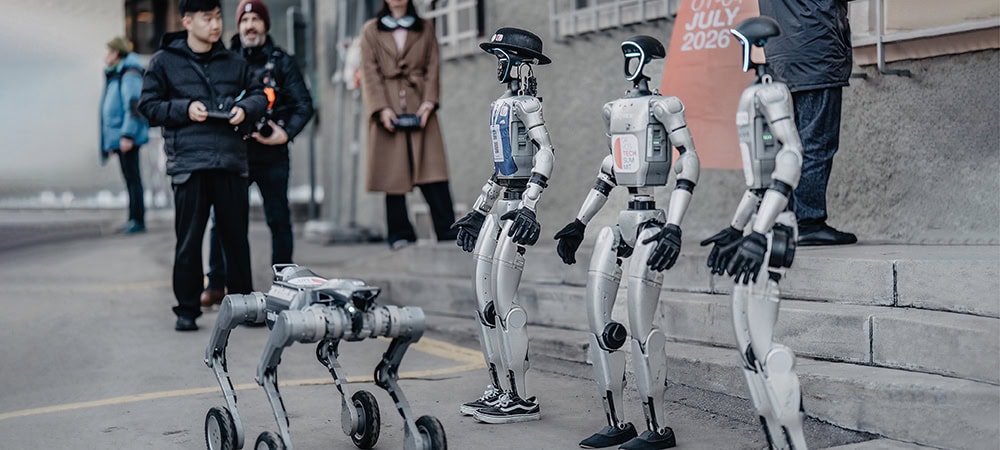


Following the success of last year's inaugural event, Data Migration International hosted its second Digital Lounge@Davos 2026 from 19 to 23 January. The forum for future-oriented technologies focused on artificial intelligence, autonomous systems and their practical application. The 300 or so visitors were particularly impressed by how far development has already progressed. The humanoid robots on show demonstrated their capabilities live. They moved independently, perceived their surroundings and interacted directly with those present.
Human-like, not -like
The orientation towards the human form follows a pragmatic approach: the entire infrastructure of the economy and society is tailored to the human anatomy, from buildings and transportation routes to workplaces. Accordingly, human-like robots do not require elaborate adaptations to their environment, but can find their way around the environment they literally enter, make decisions and act accordingly. In addition, the more familiar shape from a human perspective reduces fear of contact and thus facilitates communication and interaction between humans and machines. The technology shows its potential particularly where human resources are scarce, monotonous processes dominate or continuous operation is required. In addition, humanoid robots can be used in areas that are problematic or dangerous for humans, for example in confined spaces, high-risk working environments or when working in extreme conditions.

Cooperate, don't displace
One of the key findings of the participants at the Digital Lounge@Davos 2026 was that humanoid robots are not designed to replace human workers. Instead, they are designed to support people and enhance and improve their skills. They are intended to relieve people of stressful or dangerous tasks and create space for tasks that require human creativity, judgment and empathy. Automation does have tangible economic benefits. However, humanoid robots offer the greatest potential for productivity gains in a productive partnership between man and machine. This partnership was experienced live in Davos when the humanoid robots presented accompanied and supported people on the snow-covered sidewalks or regulated traffic to get from one side of the road to the other. Such complex scenarios were made possible by the collaboration between Data Migration International, research institutes and start-ups at ETH Zurich.
„Davos is increasingly developing into a center for innovative technologies. The interest in this is overwhelming, as our Digital Lounge@Davos 2026 has shown,“ emphasizes Thomas Failer and adds: „Accordingly, we will actively support the idea and concept of the planned Davos Tech Summit in July, when the place will be transformed into a city for robots and people alike.“ (Source: DMI)



 Deutsch
  English
  Español
  Français